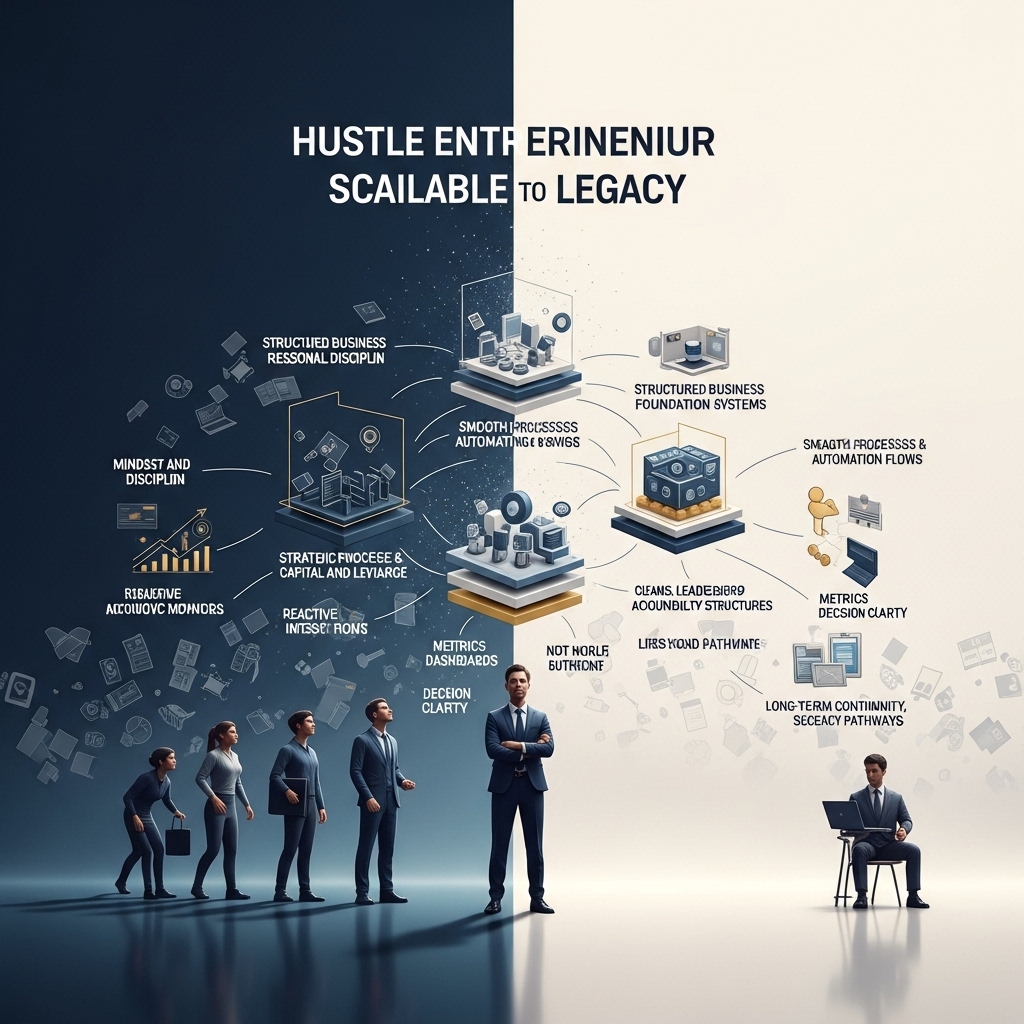
From Hustle to Legacy: The Complete Real Life XP Framework for Scaling a Business That Works in Real Life
Introduction: Scaling Isn’t About Doing More — It’s About Becoming More
Most entrepreneurs don’t struggle because they lack effort.
They struggle because growth exposes every weakness in the way a business is built — and in the person building it.
Scaling doesn’t simply increase revenue.
It increases pressure, complexity, responsibility, and visibility.
👉 If the foundation isn’t solid, growth becomes a burden instead of a breakthrough.
That’s why the Real Life XP Framework exists. It’s not a collection of tactics — it’s a complete system for scaling in real life, where businesses must grow alongside family responsibilities, mental health, financial reality, and long-term goals.
This final blog ties together all eight previous pillars into one cohesive roadmap — from hustle to legacy.
Stage 1: Mindset & Motivation — Scaling Starts With the Entrepreneur
Every business is limited by the mindset of its owner.
Early-stage hustle is fueled by urgency. But urgency doesn’t scale. As the business grows, the entrepreneur must develop:
Emotional discipline
Decision-making capacity
Clarity under pressure
Identity beyond “doing everything”
Scaling requires becoming a leader, not just a worker.
Without this internal shift:
Systems won’t stick
Teams won’t function
Capital will be misused
Growth will feel chaotic
Scale the person first, or the business will break them.
Stage 2: Business Formation & Systems — Turning Hustle Into Infrastructure
Informal businesses can make money — but they cannot scale sustainably.
Real growth requires:
Proper legal and financial separation
Documented operations
Defined roles
Clear ownership of responsibility
Structure creates legitimacy, clarity, and transferability.
This is where the business stops being a side hustle and becomes an enterprise capable of growth, funding, and expansion.
Stage 3: Process & Automation — Scaling Without Burnout
Growth should not cost your health, peace, or relationships.
Processes remove work from your head.
Automation removes repetition from your day.
Together, they:
Reduce stress
Increase consistency
Protect energy
Allow the business to operate without constant involvement
Scaling the system — not the sacrifice — is the goal.
Stage 4: Credit & Capital — Fueling Growth With Leverage
Cash-only growth limits speed and increases personal risk.
Strategic entrepreneurs use leverage to:
Act on opportunities
Smooth cash flow
Expand capacity
Reduce stress
Business credit and capital allow growth without draining reserves or tying everything to personal finances.
Capital should multiply discipline — not mask dysfunction.
Stage 5: Marketing & Branding — Attracting the Right Growth
Scaling isn’t about more attention — it’s about better alignment.
Clear positioning and consistent messaging:
Attract qualified clients
Repel misaligned ones
Reduce sales friction
Create trust at scale
Marketing becomes predictable when it’s systemized and intentional — not reactive.
Stage 6: Leadership & Team Building — Scaling Through People
No business scales alone.
Leadership transforms hiring from a relief tactic into a growth strategy.
At this stage, the entrepreneur:
Shifts from doing to directing
Builds accountability structures
Develops leaders, not just helpers
People create leverage — but only when leadership creates clarity.
Stage 7: Metrics & Decision-Making — Scaling With Clarity
Growth without visibility is just guessing.
Metrics replace emotional reactions with informed decisions.
Clarity allows entrepreneurs to:
Spot problems early
Allocate resources wisely
Avoid overcorrection
Lead with confidence
What gets measured gets managed — and scaled.
Stage 8: Legacy & Impact — Building Beyond the Founder
The final stage of scaling is no longer about income.
It’s about:
Continuity
Transferability
Influence
Generational value
Legacy businesses operate without founder dependency. They create opportunities for others and endure beyond the original vision carrier.
Legacy is not accidental — it’s designed.
How the Real Life XP Framework Works as a Whole
Each pillar builds on the previous one:
Mindset supports systems
Systems support automation
Automation supports teams
Teams support growth
Growth requires capital
Capital demands clarity
Clarity enables legacy
Remove one pillar, and the structure weakens.
Together, they form a real-life-ready scaling framework — one that acknowledges entrepreneurs don’t live in theory. They live in responsibility, pressure, and limited time.
Why This Framework Works in Real Life
Real Life XP works because it:
Respects the human behind the business
Addresses structure before strategy
Focuses on sustainability over hype
Aligns growth with life — not against it
It’s not about becoming a different person.
It’s about becoming a more capable version of yourself.
Conclusion: Scaling Is a Journey, Not a Hack
There is no shortcut to sustainable scale.
But there is a framework that prevents common mistakes, reduces burnout, and creates businesses that work in real life — not just on paper.
The Real Life XP Framework exists to help entrepreneurs move from:
Hustle to structure
Chaos to clarity
Income to impact
Ownership to legacy
Scaling isn’t about doing more.
It’s about building something that works without costing you everything else.
And when done right, scaling doesn’t just change your business — it changes your life.


