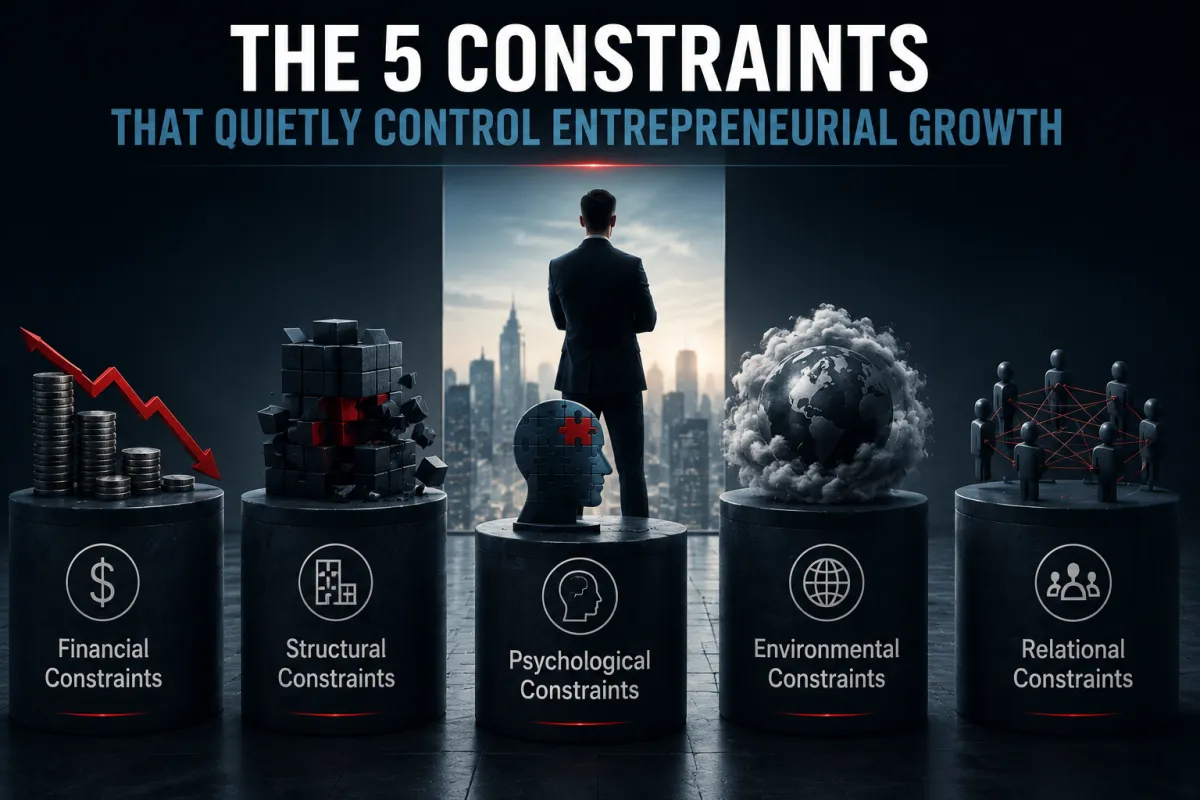
The 5 Constraints That Quietly Control Entrepreneurial Growth
Most entrepreneurs focus on opportunity while ignoring constraints. Yet constraints are often the true determinants of growth. Constraint Navigation Capacity identifies five major categories of constraints that quietly shape entrepreneurial performance.
The first category is Financial Constraints. These include limited cash flow, lack of access to capital, poor credit structures, and unstable revenue. Financial constraints create pressure that forces entrepreneurs into reactive decision-making. Without financial stability, a long-term strategy becomes difficult.
The second category is Structural Constraints. Structural deficiencies occur when businesses lack systems, documented processes, operational workflows, or scalable infrastructure. Many entrepreneurs build businesses entirely dependent on themselves. Growth then exposes weaknesses in operations and delivery.
The third category is Psychological Constraints. Fear, self-doubt, burnout, emotional exhaustion, and trauma-informed thinking patterns all affect entrepreneurial decision-making. Entrepreneurs operating under chronic pressure often struggle with risk tolerance, delegation, and consistency.
The fourth category is Environmental Constraints. Entrepreneurs do not operate in isolation. Family responsibilities, unstable environments, economic conditions, community limitations, and lack of mentorship can significantly impact performance and opportunity.
The fifth category is Relational Constraints. Leadership challenges, poor communication, lack of team trust, weak partnerships, and limited professional networks can restrict scalability. Many entrepreneurs struggle to build healthy teams because they have never experienced strong operational leadership.
Most entrepreneurs fail to identify their dominant constraint. Instead, they attack symptoms. For example, someone may believe they need more marketing when the actual issue is operational inconsistency. Others pursue more revenue while ignoring leadership limitations that prevent sustainable scale.
This is why CNC emphasizes the principle: “What remains unidentified remains unresolved.” Growth slows wherever constraints remain invisible.
Every business has a dominant constraint at each stage of development. Identifying that constraint creates clarity. Once clarity exists, entrepreneurs can build systems, structures, and strategies to increase navigation capacity.
The entrepreneurs who grow sustainably are not those who avoid constraints. They are those who identify them early and navigate them strategically.


