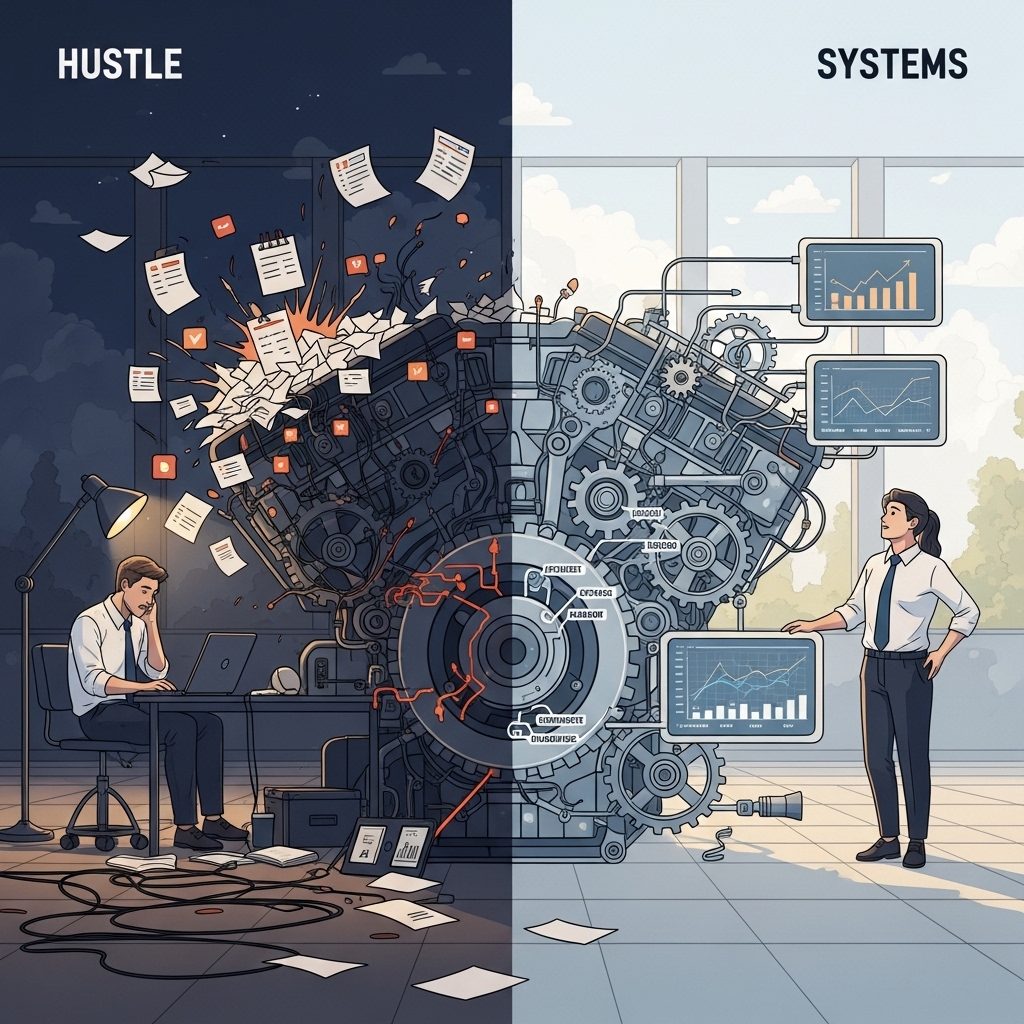
The Real Problem Isn’t Hustle — It’s Structural Failure
Why Most Entrepreneurs Work Harder and Still Don’t Grow
Most entrepreneurs don’t fail because they lack ambition. They fail because ambition alone cannot compensate for broken structure.
Hustle culture has convinced an entire generation of business owners that effort is the solution to every problem. If revenue is inconsistent, work longer hours. If marketing isn’t converting, post more content. If operations feel overwhelming, push harder and sleep less.
For a while, that works.
Then it doesn’t.
At a certain point, effort stops producing progress. The business becomes heavier. Every new client adds stress instead of stability. Time freedom disappears. Growth feels unpredictable, fragile, and exhausting. This is the moment most entrepreneurs internalize failure—believing something is wrong with them.
But the real issue isn’t personal.
It’s structural.
Hustle Is a Short-Term Strategy With a Hard Ceiling
Hustle works in the early stages because the business is small enough to be powered by one person’s energy. Decisions are fast. Systems are informal. Mistakes are survivable. The founder is the system.
But that model has a ceiling.
Once demand increases, complexity increases. More clients mean more communication, more fulfillment, more follow-up, more accounting, more decision-making. Without systems, every additional dollar earned requires disproportionate effort.
This is why so many entrepreneurs plateau at the same revenue ranges:
$50K–$75K
$100K–$150K
$250K
It’s not a motivation gap. It’s an infrastructure gap.
Hustle doesn’t scale. Systems do.
The Misdiagnosis That Keeps Entrepreneurs Stuck
When growth stalls, most advice focuses on mindset:
“You need to want it more.”
“You’re not disciplined enough.”
“You’re playing small.”
While mindset matters, it is rarely the root cause at this stage.
The Real Life Growth Engine was created to correct this misdiagnosis.
It starts from a different assumption: most entrepreneurs are already working at or near their capacity. Asking them to do more without changing the system only accelerates burnout.
The correct question isn’t:
“How do I work harder?”
It’s:
“Why des my business require this much effort to function at all?”
That question shifts the focus from motivation to mechanics.
Growth Is Mechanical, Not Emotional
The Real Life Growth Engine reframes business growth as a mechanical process.
Just like a physical engine, a business requires:
Proper alignment
Load balance
Sequential engagement
Ongoing maintenance
When one component is missing or overloaded, the entire system strains. No amount of motivation fixes a misaligned engine. It only causes more damage.
Entrepreneurs are taught to “push through” resistance. But resistance is often feedback, not failure.
If growth feels heavy, something is misaligned.
Why “Busy” Is a Warning Sign, Not a Badge of Honor
Many entrepreneurs wear busyness as proof of commitment. Long hours feel virtuous. Exhaustion feels earned.
But busyness is often a symptom of:
Undefined processes
Manual operations
Poor prioritization
Founder dependency
In a properly structured business, activity decreases as output increases. Time is reclaimed as systems take over repetitive decisions and actions.
If revenue growth is accompanied by rising stress, shrinking margins, or declining quality of life, the business is not growing—it’s expanding dysfunction.
The Growth Engine exists to prevent that outcome.
Real-Life Constraints Require Real-Life Systems
Traditional business education assumes ideal conditions:
Stable access to capital
Predictable schedules
Supportive environments
Minimal personal disruption
The Real Life Growth Engine assumes the opposite.
It was built for entrepreneurs navigating:
Limited financial margin
Family responsibilities
Nontraditional backgrounds
Inconsistent support systems
High personal pressure
This framework doesn’t require perfection. It requires structure that works under pressure.
Systems aren’t about control for control’s sake. They’re about creating stability where chaos would otherwise exist.
Structure Is What Turns Effort Into Equity
Without structure, effort disappears when the entrepreneur steps away.
With structure, effort compounds.
A documented process doesn’t forget.
An automated workflow doesn’t get tired.
A defined system doesn’t depend on mood or energy.
This is how effort turns into equity instead of exhaustion.
The Growth Engine is designed to help entrepreneurs:
Reduce decision fatigue
Stabilize operations
Predict outcomes
Scale without personal collapse
Not by working harder—but by working differently.
The Shift From Survival to Sustainability
Most entrepreneurs start in survival mode. That’s normal. What’s dangerous is staying there.
Survival mode prioritizes urgency over importance. Everything feels critical. Long-term thinking gets postponed. Systems feel like luxuries instead of necessities.
The Growth Engine creates a bridge from survival to sustainability.
It replaces:
Guesswork with clarity
Chaos with order
Reaction with intention
This isn’t about slowing down growth. It’s about making growth repeatable.
Why Structure Is the Ultimate Freedom Tool
Entrepreneurs often resist structure because it feels restrictive.
In reality, structure is what creates freedom.
Freedom from:
Constant firefighting
Revenue anxiety
Founder bottlenecks
Burnout cycles
Structure allows the business to function without constant intervention. It creates optionality. It gives the entrepreneur leverage.
The goal of the Growth Engine isn’t just higher revenue. It’s control.
Control over time.
Control over decisions.
Control over direction.
The Foundation of the Real Life Growth Engine
Everything in the Real Life Growth Engine builds on this first principle:
Effort without structure is unsustainable.
Growth doesn’t fail because entrepreneurs aren’t strong enough. It fails because the business wasn’t built to carry the weight of expansion.
The solution isn’t more hustle.
It’s a better engine.


