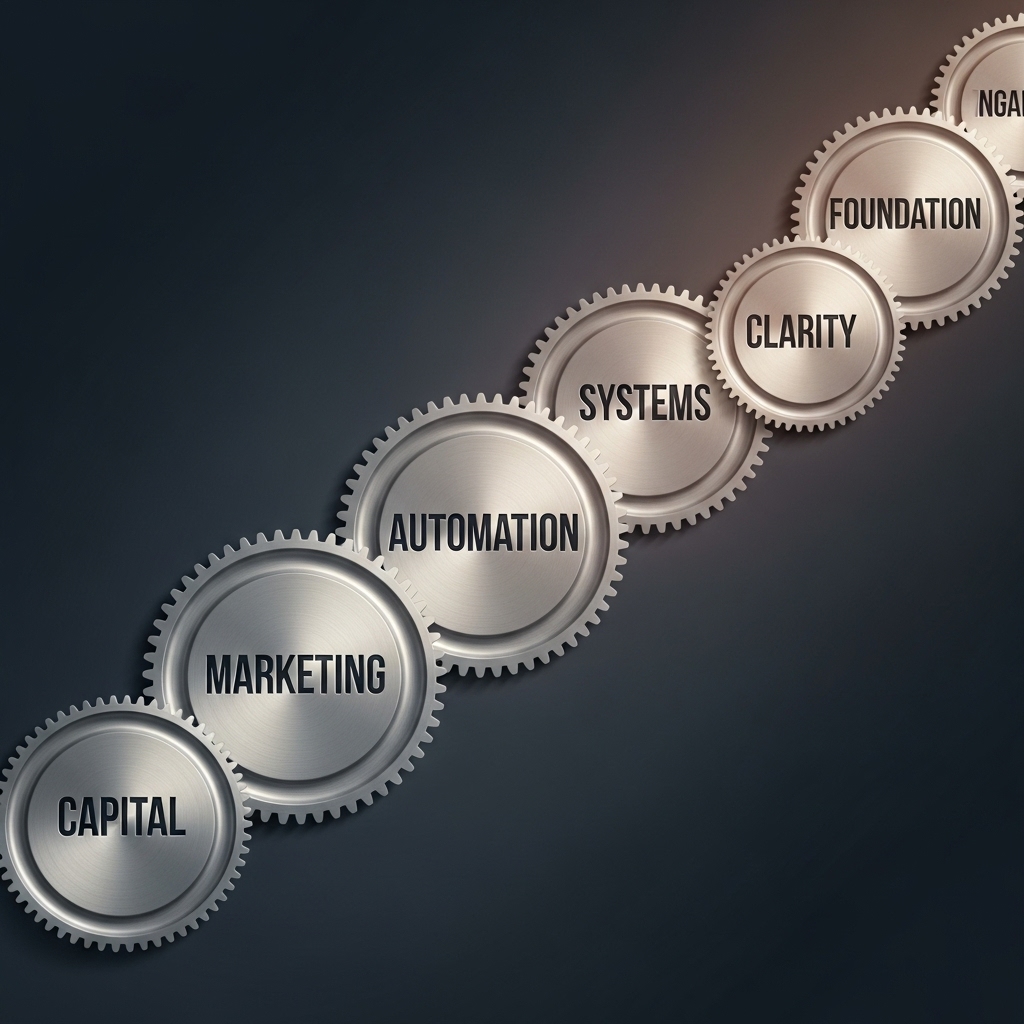
The Seven Growth Gears — How Progress Actually Happens
Why Growth Feels Impossible Until the Right Gear Engages
One of the most frustrating experiences an entrepreneur can have is doing “everything right” and still not seeing progress.
You’re working consistently.
You’re investing in yourself.
You’re showing up every day.
Yet growth feels slow, unpredictable, or completely stalled.
This is where most entrepreneurs assume they need to push harder. In reality, the issue is rarely effort. The issue is misalignment.
The Real Life Growth Engine explains growth through a mechanical lens, using Seven Growth Gears. Each gear controls a specific function of the business, and each must engage in the correct order for progress to occur.
When entrepreneurs try to force growth without engaging the right gear, the engine strains. Momentum stalls. Burnout increases. Results feel random.
Growth isn’t blocked because you’re incapable.
It’s blocked because the wrong gear is engaged.
Why Growth Feels Inconsistent for So Many Entrepreneurs
Most businesses don’t fail outright. They stall.
Revenue fluctuates. One month is strong, the next is weak. New clients come in, but the business feels heavier instead of healthier. The founder becomes the bottleneck—handling sales, delivery, decisions, and problem-solving.
This inconsistency creates anxiety. Entrepreneurs start chasing tactics instead of fixing structure. They jump from strategy to strategy, hoping the next one “finally works.”
But tactics don’t fix structural problems.
The Growth Engine teaches that progress happens sequentially, not simultaneously. Each gear prepares the business for the next phase of growth.
Skipping gears doesn’t save time—it creates setbacks.
Overview: The Seven Growth Gears
The Seven Growth Gears are:
Foundation Gear
Clarity Gear
Systems Gear
Automation Gear
Marketing Gear
Capital Gear
Scale Gear
Each gear controls a specific constraint. Until that constraint is resolved, growth cannot move forward smoothly.
Let’s break them down.
Gear 1: The Foundation Gear
Stability Before Speed
The Foundation Gear determines whether the business can support growth at all.
This gear includes:
Personal discipline and capacity
Basic financial control
Cash flow awareness
Operational stability
Many entrepreneurs try to grow while standing on unstable ground. Finances are unclear. Pricing is inconsistent. Personal stress bleeds into business decisions.
When the foundation is weak, growth magnifies instability.
The Foundation Gear asks one core question:
Is this business stable enough to handle more demand?
If the answer is no, growth becomes dangerous instead of desirable.
This gear isn’t glamorous—but it’s non-negotiable.
Gear 2: The Clarity Gear
Focus Creates Momentum
Once stability exists, clarity becomes the next constraint.
Clarity means:
A clearly defined offer
A specific target customer
Clear priorities
Defined roles (even if you’re solo)
Without clarity, effort gets scattered. Entrepreneurs chase multiple ideas, tweak offers constantly, and shift direction under pressure.
The Clarity Gear removes noise.
It forces decisions:
What are we selling?
To whom?
Why this offer?
What matters now—and what doesn’t?
Clarity doesn’t limit opportunity. It concentrates energy.
Momentum begins here.
Gear 3: The Systems Gear
From Talent to Repeatability
The Systems Gear is where many entrepreneurs resist—but it’s where real growth begins.
Systems are documented processes that define:
How work gets done
Who does it
In what order
To what standard
Without systems, success depends on memory, effort, and heroics. With systems, success becomes repeatable.
This gear removes founder dependency.
It transforms the business from something that works because of you into something that works without constant intervention.
Systems don’t slow you down. They remove friction.
Gear 4: The Automation Gear
Leverage Through Technology
Once systems are defined, automation becomes possible.
Automation is not about replacing people—it’s about removing unnecessary manual effort.
This gear includes:
CRM workflows
Automated follow-ups
Scheduling systems
Payment processing
Client onboarding
Automation protects time and energy.
Without it, founders spend hours on low-value tasks that don’t drive growth. With it, the business operates consistently—even when the founder steps away.
Automation is what allows the engine to run without constant supervision.
Gear 5: The Marketing Gear
Predictable Demand, Not Hope
Most entrepreneurs try to start here.
That’s the mistake.
Marketing works best after foundation, clarity, systems, and automation are in place.
When the Marketing Gear engages properly, demand becomes predictable. Messaging is clear. Conversion improves. Fulfillment doesn’t collapse under pressure.
Marketing is not about visibility alone—it’s about controlled growth.
This gear turns attention into revenue without overwhelming the business.
Gear 6: The Capital Gear
Fuel for a Functional Engine
Capital is one of the most misunderstood aspects of growth.
Money doesn’t fix broken systems.
Money accelerates whatever already exists.
The Capital Gear should only engage once the business demonstrates operational control.
This gear includes:
Business credit
Funding
Cash reserves
Financial leverage
When engaged at the right time, capital allows:
Faster scaling
Strategic hiring
Market expansion
Engaged too early, it amplifies chaos.
Gear 7: The Scale Gear
From Operator to Architect
The final gear is scale.
This is not just about revenue—it’s about role transition.
At this stage, the founder must shift from:
Doing → directing
Managing → leading
Reacting → planning
The Scale Gear requires:
Leadership systems
Delegation frameworks
Accountability structures
Growth here is intentional, not accidental.
Why Skipping Gears Always Backfires
Entrepreneurs often skip gears to “save time.”
They market without systems.
They seek funding without stability.
They hire without clarity.
Each shortcut creates future drag.
The Growth Engine exists to eliminate unnecessary friction by respecting sequence.
Growth feels hard when sequence is ignored.
Growth feels inevitable when sequence is followed.
Growth Is Predictable When the Engine Is Aligned
When the right gear engages at the right time:
Effort decreases
Results stabilize
Stress drops
Confidence increases
This is why some businesses feel chaotic forever—and others compound steadily.
It’s not talent.
It’s not luck.
It’s alignment.
Final Thought
The Seven Growth Gears aren’t theory. They’re a diagnostic tool.
If growth feels stuck, ask:
Which gear isn’t engaged?
The answer always reveals the path forward.


