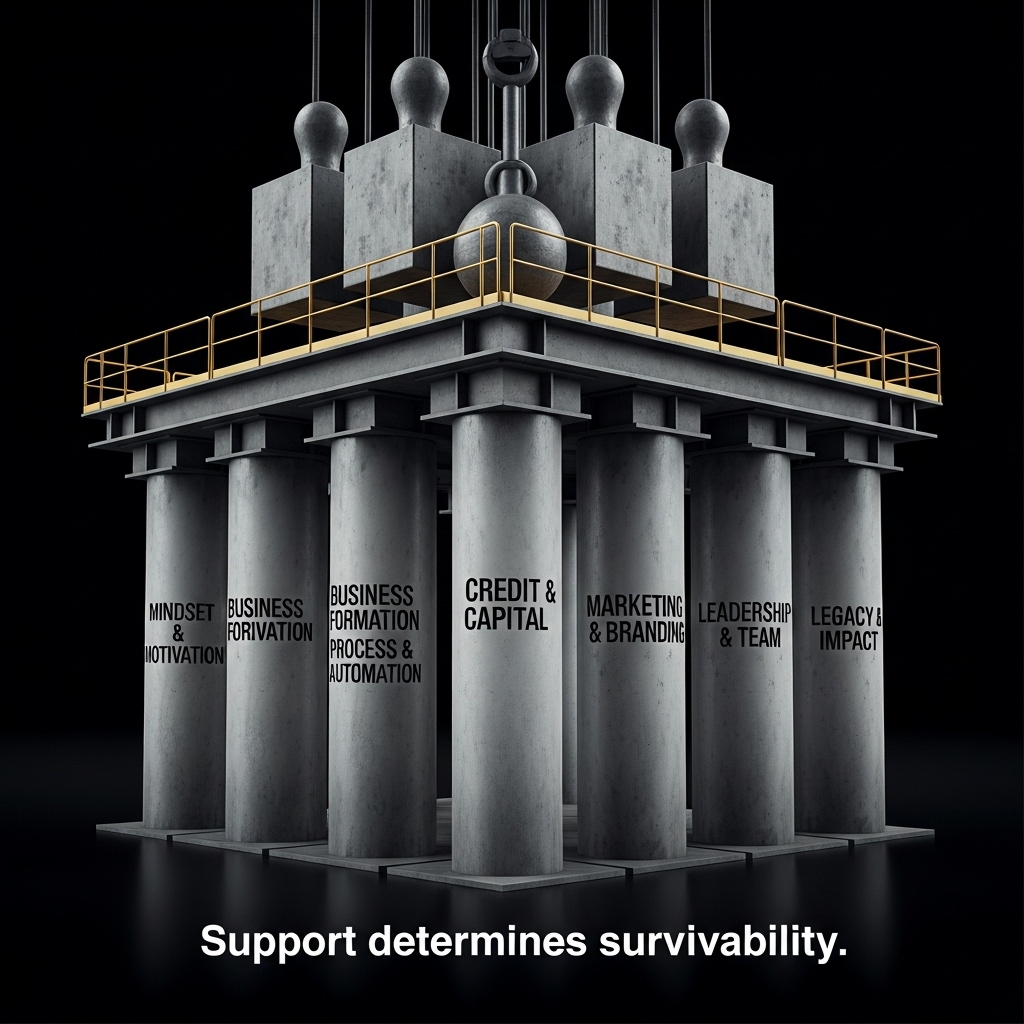
The Seven Pillars That Support Sustainable Growth
What Holds a Business Up When Pressure Increases
Most businesses don’t collapse overnight.
They weaken slowly.
Revenue may still come in. Clients may still be served. From the outside, things can look “fine.” But internally, stress increases, decisions feel heavier, and the margin for error shrinks.
This is what happens when growth outpaces support.
In the Real Life Growth Engine, Gears create movement, but Pillars provide stability. Without strong pillars, growth becomes dangerous. The business may move forward—but it does so on a fragile foundation.
The Seven Pillars define what must be structurally sound for a business to survive pressure, change, and expansion.
Why Growth Without Support Eventually Breaks Businesses
As demand increases, everything is tested:
Decision-making
Financial controls
Team dynamics
Leadership capacity
Infrastructure
If the business lacks structural support, growth exposes weaknesses instead of creating opportunity.
This is why some businesses grow into burnout instead of freedom.
The Growth Engine doesn’t treat these failures as personal shortcomings. It treats them as engineering problems.
Pillars exist to distribute weight.
Pillar 1: Mindset & Motivation
The Discipline to Execute Systems
Mindset in the Growth Engine isn’t about hype or positivity. It’s about discipline under pressure.
This pillar includes:
Decision-making clarity
Emotional regulation
Focus and follow-through
Willingness to build long-term structure
Without the right mindset, entrepreneurs sabotage systems they desperately need. They abandon structure when results aren’t immediate. They chase urgency instead of importance.
Sustainable growth requires the mental capacity to delay gratification and execute boring but necessary work.
This pillar ensures the entrepreneur doesn’t become the weakest link.
Pillar 2: Business Formation & Structural Integrity
Legal and Financial Stability
Many entrepreneurs underestimate how much stress poor formation creates.
This pillar covers:
Proper business setup
Separation of personal and business finances
Compliance and documentation
Financial organization
Without this pillar, growth increases risk. Opportunities get missed. Funding becomes difficult. Simple mistakes become expensive.
Structure here doesn’t slow growth—it protects it.
Pillar 3: Process & Automation
Consistency Beats Talent
Talent creates peaks. Process creates plateaus—and plateaus are scalable.
This pillar ensures work is:
Documented
Repeatable
Measurable
Automation supports these processes by removing manual effort and reducing errors.
Without this pillar, businesses rely on memory and effort. Growth becomes unpredictable.
This pillar stabilizes output regardless of who is working.
Pillar 4: Credit & Capital
Leverage Without Dependency
Capital is not about survival—it’s about leverage.
This pillar focuses on:
Access to credit
Funding readiness
Cash management
Strategic use of leverage
Without this pillar, growth opportunities become stressful decisions. With it, growth becomes a calculated move.
Capital should enter a business that already has structure—not one hoping money will create it.
Pillar 5: Marketing & Branding
Visibility With Integrity
Marketing isn’t just about attention—it’s about positioning.
This pillar ensures:
Clear messaging
Consistent presence
Trust-building visibility
Without a strong brand, marketing becomes noise. Without marketing, even the best systems remain invisible.
This pillar connects structure to the marketplace.
Pillar 6: Leadership & Team Building
Scale Requires Other People
At a certain point, growth demands more than one person.
This pillar includes:
Hiring frameworks
Role clarity
Accountability systems
Leadership development
Without leadership structure, teams create chaos instead of leverage.
Strong leadership turns people into multipliers—not liabilities.
Pillar 7: Legacy & Impact
Growth With Direction
This pillar forces the long view.
Legacy isn’t about ego—it’s about sustainability.
This includes:
Long-term vision
Ethical decision-making
Impact beyond revenue
Transferable value
Businesses without this pillar chase short-term wins at long-term cost.
This pillar ensures growth creates something worth sustaining.
Why Pillars Must Be Reinforced Before Crisis
Most entrepreneurs wait until something breaks to reinforce structure.
The Growth Engine advocates reinforcement before pressure demands it.
Strong pillars reduce:
Emotional decision-making
Founder burnout
Reactive problem-solving
They create resilience.
The Relationship Between Gears and Pillars
Gears create movement.
Pillars create safety.
Movement without safety is reckless.
Safety without movement is stagnation.
The Growth Engine balances both.
Final Thought
If growth feels stressful, ask:
Which pillar is underdeveloped?
The answer reveals where reinforcement is needed.


