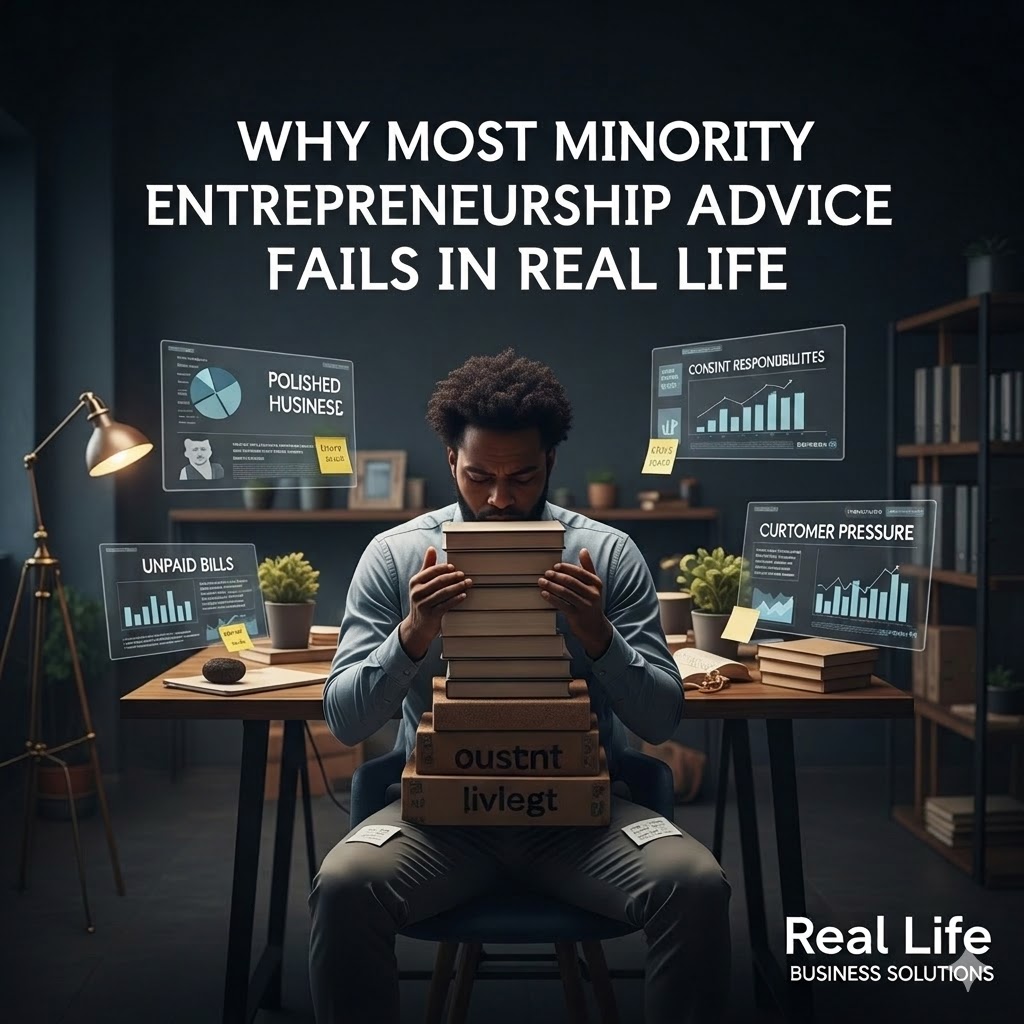
Why Most Minority Entrepreneurship Advice Fails in Real Life
Why Most Minority Entrepreneurship Advice Fails in Real Life
Most minority entrepreneurs don’t fail because they lack talent.
They fail because they were taught the wrong game.
Not intentionally. Not maliciously. But systematically.
The business advice they were given was never designed for their reality.
And that mismatch? That’s the real problem.
The Advice Sounds Right… Until You Try to Live It
“Just focus on one thing.”
“Invest in yourself.”
“Take risks.”
“Delay gratification.”
“Build long-term.”
On paper, all of that is solid advice.
But here’s the truth nobody says out loud:
That advice assumes you have margin.
Margin in your finances.
Margin in your time.
Margin in your responsibilities.
Margin in your emotional bandwidth.
Most minority entrepreneurs don’t start with margin.
They start with pressure.
Privilege vs Pressure: Two Different Starting Lines
Traditional entrepreneurship advice was built for people who had:
• Financial cushions
• Support systems
• Access to mentorship
• Time to fail quietly
• Space to experiment
But minority entrepreneurs often start with:
• Financial responsibility to others
• Limited access to capital
• No mentorship or guidance
• Immediate pressure to produce income
• High consequences for failure
That’s not a small difference.
That’s a completely different operating environment.
And yet, both groups are handed the same playbook.
The Problem Isn’t Execution — It’s Misalignment
When someone says:
“Just reinvest everything back into the business”
That works… if you’re not helping your family financially.
When someone says:
“Focus on long-term brand building”
That works… if your rent isn’t due in 14 days.
When someone says:
“Be patient, success takes time”
That works… if your survival doesn’t depend on speed.
So what happens?
Minority entrepreneurs try to follow this advice…
It doesn’t work in their reality…
And they blame themselves.
They think:
• “I must not be disciplined enough”
• “I must not be focused enough”
• “I must not be smart enough”
But that’s not the truth.
The truth is:
You were given a strategy that doesn’t match your starting conditions.
Entrepreneurship Without a Blueprint
Many minority entrepreneurs are building businesses without:
• Family examples of entrepreneurship
• Financial literacy training
• Exposure to scalable systems
• Guidance on capital and credit
They’re not just building a business.
They’re building:
• their identity,
• their strategy,
• and their structure…
All at the same time.
That’s a heavier lift than most people realize.
As outlined in the Real Life XP framework, the problem isn’t just tactical—it’s foundational. Most entrepreneurs were never given a structured path that accounts for real-life conditions like financial pressure, instability, and responsibility .
So instead of building from structure…
They build from survival.
Survival Mode Is Not a Strategy
Survival mode creates:
• Short-term decisions
• Reactive thinking
• Inconsistent execution
• Emotional burnout
It forces you to prioritize:
• Immediate cash over long-term growth
• Urgency over strategy
• Activity over leverage
And here’s the dangerous part:
Survival mode can look like productivity.
You’re working.
You’re grinding.
You’re moving.
But you’re not scaling.
The Hustle Trap
Hustle is necessary in the beginning.
But most minority entrepreneurs never transition out of it.
Why?
Because hustle is what got them through life.
• Hustle got them through financial hardship
• Hustle got them through instability
• Hustle built their resilience
So naturally, they apply the same approach to business.
But here’s the truth:
What helps you survive will not help you scale.
Hustle builds income.
Structure builds freedom.
Linear Effort vs Exponential Growth
Most entrepreneurs are operating in linear mode:
• More work = more money
• More time = more output
• More effort = more results
But linear growth has limits.
You burn out.
You plateau.
You get stuck.
Exponential growth is different.
It’s built on:
• Systems
• Automation
• Delegation
• Strategic thinking
It’s not about working harder.
It’s about building something that works without you doing everything.
As the Real Life XP framework emphasizes, exponential progress comes from systems multiplying your effort—not just effort itself.
The Real Issue: No Translation Layer
The real problem isn’t that traditional business advice is wrong.
It’s that it was never translated.
No one adapted it for:
• entrepreneurs with pressure instead of privilege
• entrepreneurs building while rebuilding their lives
• entrepreneurs carrying responsibility beyond themselves
So people are trying to apply advanced strategies…
Without the foundational structure required to support them.
That’s like trying to scale a business on a cracked foundation.
Eventually, it collapses.
What Minority Entrepreneurs Actually Need
They don’t need more information.
They need:
1. Structure Before Scale
Turn chaos into systems before trying to grow.
2. Stability Before Strategy
Create predictable income before long-term plays.
3. Identity Before Execution
Shift from survival mindset to CEO mindset.
4. Systems Before Hustle
Build leverage, not just activity.
This Isn’t About Disadvantage — It’s About Design
This conversation isn’t about making excuses.
It’s about acknowledging reality.
Because once you understand the real problem…
You can build the right solution.
Minority entrepreneurs don’t lack capability.
They lack aligned frameworks.
And when you give the right structure to someone who already has:
• resilience
• discipline
• adaptability
• hunger
They don’t just succeed.
They scale faster than most.
The Shift That Changes Everything
The moment things change is when you stop asking:
“Why isn’t this working for me?”
And start asking:
“What system would work for someone in my position?”
That question changes everything.
Because now you’re not trying to fit into someone else’s model.
You’re building one that fits your reality.
Final Thought
Entrepreneurship is not one-size-fits-all.
And pretending it is… has cost too many people time, money, and confidence.
The goal isn’t to work harder.
The goal is to build smarter.
Not based on theory.
But based on real life.


